Engine/Effects/Learning Aids

Learning Objectives and Key Takeaways

Two ten-second cards that frame the lecture: what the student will be able to do, shown just after the welcome, and the three ideas worth carrying away, shown at the very end. Each card holds exactly three one-line statements, drawn in the lecture's own style, with music under them — and, when the course wants it, a generated narrator reading them aloud with each line lighting up as it is read.

3 lines in · 3 lines out · 10 s each

The finished effect

What it looks like when it is done.

The learning objectives and key takeaways cards from a produced lecture: three short lines each, arriving in order and settling to full brightness before the card ends.

81 s · 1920 × 1080 · with sound

Overview

What it is, and why it exists.

Learning Objectives and Key Takeaways are the two list cards among the four short pieces that frame every finished lecture. The complete film runs welcome, then Learning Objectives, then the lecture itself, then the end note, then Key Takeaways. The welcome and end note are covered on their own page; this page is about the two cards that say what the lecture is for and what it leaves behind.

The problem they solve is a familiar one. A recorded lecture rarely states its purpose cleanly: objectives are either missing, or spread across a minute of 'today we will look at…', or given three separate times before anything is taught. One real recording we re-cut spent 103 of its first 134 seconds on three overlapping statements of what the student was about to learn. These cards replace all of that with one tight, ten-second statement at each end — three lines, each one sentence long, which is about as much as a student can still repeat at the end of the session.

The lines themselves are not written by the engine. They belong to the lecture and arrive with it, in the course sheet row for that recording, next to the university, programme, course, module and topic. There is no default and no fallback: what a student should be able to do after a topic cannot be guessed from the topic's name, so if the lines are missing the build stops and says so rather than printing something generic.

By default the cards are not spoken. Nobody on camera says these lines, a student does not need a voice to read three short statements, and a card that is read aloud has to run as long as the reading takes. So each card has a fixed length and its animation is planned as fractions of that length, with a music bed under it. Narration is an option: the same text is sent to the voice model, the read is transcribed with the same speech recognition the lecture went through, and each line arrives on the words that say it.

2 — objectives after the welcome, takeaways at the very endCards
Exactly 3, one sentence eachLines per card
10.0 s each by default (overridable per card)Length
0.9 s, 3.45 s, 6.0 sLine arrivals (10 s card)
From 6.45 s — 3.55 s left to readAll lines full brightness
Music bed at −20 LUFS; −16 LUFS when narratedAudio
0.88× speed, 0.7 s pause between linesNarration pace
1920×1080, 30 fps, rendered frame by frameFrame

How it is made

Step by step, in the order the engine runs it.

Read the lines from the course sheet

The engine opens the lecture's metadata — the course sheet's row for this recording — and takes the objectives and takeaways lists from it. If either list is missing the build stops with a plain message saying where the three lines go. If a list has more or fewer than three lines the build continues but prints a warning, because three is the shape the cards are laid out for.

Decide the card's length

Each card has a length in seconds: 10.0 for both list cards. It can be changed per card for a particular lecture. When the card is narrated the length is instead set by the read: the duration of the narration plus 0.8 seconds, so the last line is never cut off mid-word.

Place the lines on a clock (silent cards)

Without narration the three lines are spread across the card as fractions of its length. The first arrives 0.9 s in. The last is placed so that 40% of the card is still to run after it lands — roughly the time three short statements take to read once they are all on screen. The middle line sits halfway between. On a 10-second card that gives 0.9 s, 3.45 s and 6.0 s.

Or place them on the words (narrated cards)

With narration on, the script is a short spoken lead-in, then each line with a 0.7-second pause before it. The voice model reads it at 0.88× normal speed. The audio is levelled to −16 LUFS, transcribed, and the first four words of each line are looked up in the transcript, searching forward from the previous match so two lines can never land on the same moment. The line appears on the first of those words.

Write the cue sheet

The card becomes a small timeline in the same format as the animated lecture itself: one dark scene, a header element (kicker and title) from 0.0 s, and a numbered list element that starts drawing 0.6 s before its first line. On silent cards the list also gets a 'settle' time, 0.45 s after the last line lands, when every line comes up to full brightness.

Build the soundtrack

The music bed for the card is cut from the job's supplied track, starting on a bar line, or synthesised if no track was supplied. On its own it is levelled to −20 LUFS; with a narrator it is ducked under the voice and the mix is levelled to −16 LUFS. A loudness envelope is measured from the finished track at 30 frames a second for the renderer.

Render every frame

The card is drawn by the same renderer that draws the animated lecture, with the lecture's style, fonts and palette, so it belongs to the same film. Each frame is computed for its exact time — 30 per second, captured five at a time — and encoded as it is produced. Nothing depends on real-time playback, so a frame always shows exactly what the timeline says.

Mux and deliver the piece

The silent picture and the soundtrack are joined into one 1920×1080 clip with 192 kbps audio. The card is finished on its own and put in place later by the join step.

Join into the complete film

The join places the pieces in order — welcome, objectives, lecture, end note, takeaways. It refuses to proceed if any piece differs in frame size, pixel format or frame rate, normalises every piece's audio to one stereo 48 kHz format, joins them without re-encoding the picture, and checks that the result is within 0.35 s of the sum of the parts.

Elements

Everything this effect puts on screen, one piece at a time.

Each element below is shown as the engine actually produced it, in the real lecture, with its parts, and the rules that govern it.

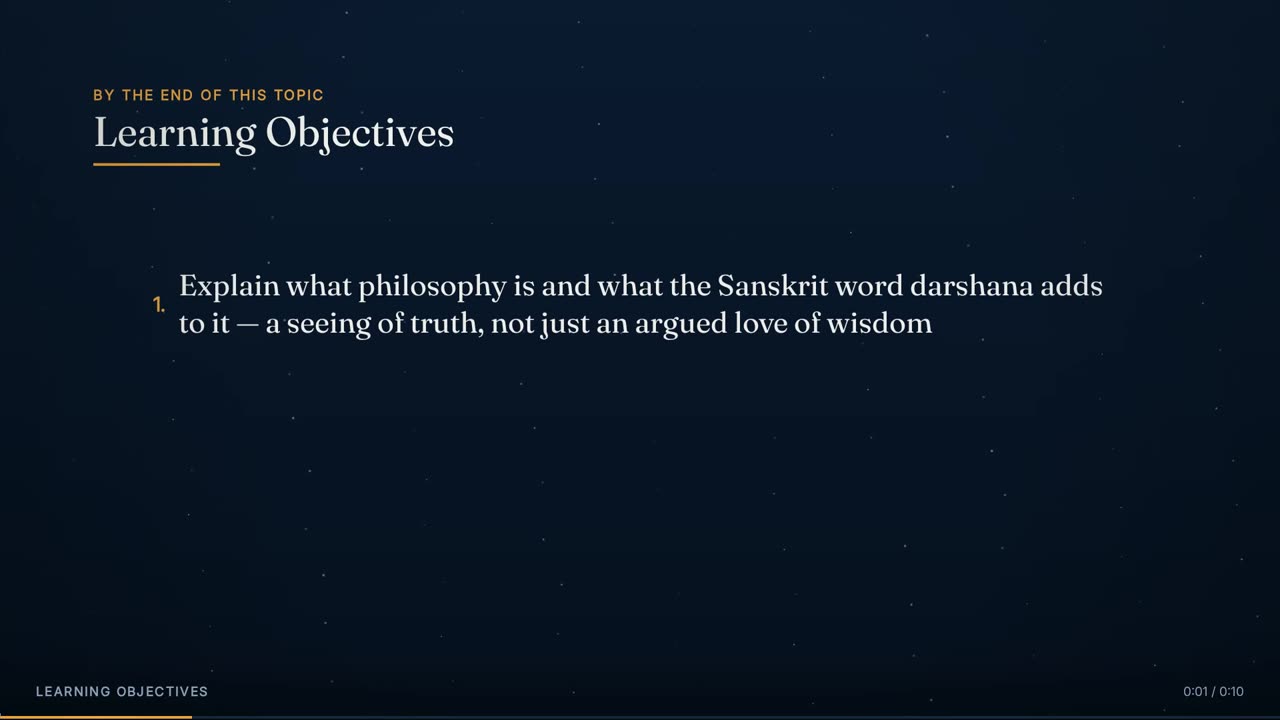
0.4 s into the objectives card: the header has almost finished rising into place and no line has arrived yet.
01

Header: kicker and title

Names the card and stays for its whole length.

The top of each card is a small kicker in capitals over a display-serif title, with a short accent rule beneath. On the objectives card the kicker reads BY THE END OF THIS TOPIC over the title Learning Objectives; on the takeaways card it reads WHAT TO CARRY AWAY over Key Takeaways. The header arrives at 0.0 s with the style's standard entrance, slightly slowed, and the rule grows out from the left as it lands. It never leaves: a viewer glancing up at any moment knows which of the two cards they are looking at.

Anatomy
  • Box 140, 150 — 1240×180 px, left-aligned
  • Kicker: interface face, bold, 21 px, accent colour (Scholar: amber #E8A03A), letter-spacing 3.0 px
  • Title: display serif, bold, fitted from 62 px down to no smaller than 30 px, line height 1.14, ink colour (Scholar: #F0EEE8)
  • Accent rule: 4 px thick, up to 190 px long, grows with the entrance
  • Entrance: 0.50 s (the style's 0.45 s × 1.11), ease-out cubic, 16 px rise
Rules
  • The kicker is fixed text per card; the title is the card's name
  • Held from the first frame to the last — never retires
1.5 s: the first objective has landed at full brightness with its amber number.
02

The three numbered lines

The content: three statements, one per row.

Below the header sit the three lines, numbered 1, 2 and 3. The list occupies a fixed box and divides it into three equal rows, so the rows never jump around as lines arrive. Each line is set in the display serif at 44 px and is automatically stepped down, one pixel at a time, until it fits its row — a long objective wraps to two lines at a smaller size rather than overrunning. The number sits right-aligned in its own gutter so the text column starts at the same x on every row.

Anatomy
  • List box 210, 380 — 1500×470 px; each row 156.7 px tall
  • Number: interface face, bold, 30 px, right-aligned at x=248, followed by a full stop
  • Text starts at x=268, maximum width about 1422 px
  • Text: display serif weight 600, 44 px target, never below 22 px, line height 1.28
  • Entrance per line: 0.45 s ease-out cubic with a 12 px rise (0.75 of the style's 16 px)
Rules
  • Exactly three lines; any other count prints a warning
  • A line is not drawn at all before its time — the card fills in step with the clock or the voice
  • Every line stays on screen once it has arrived; nothing is retired
  • Size is measured against the actual text, never guessed
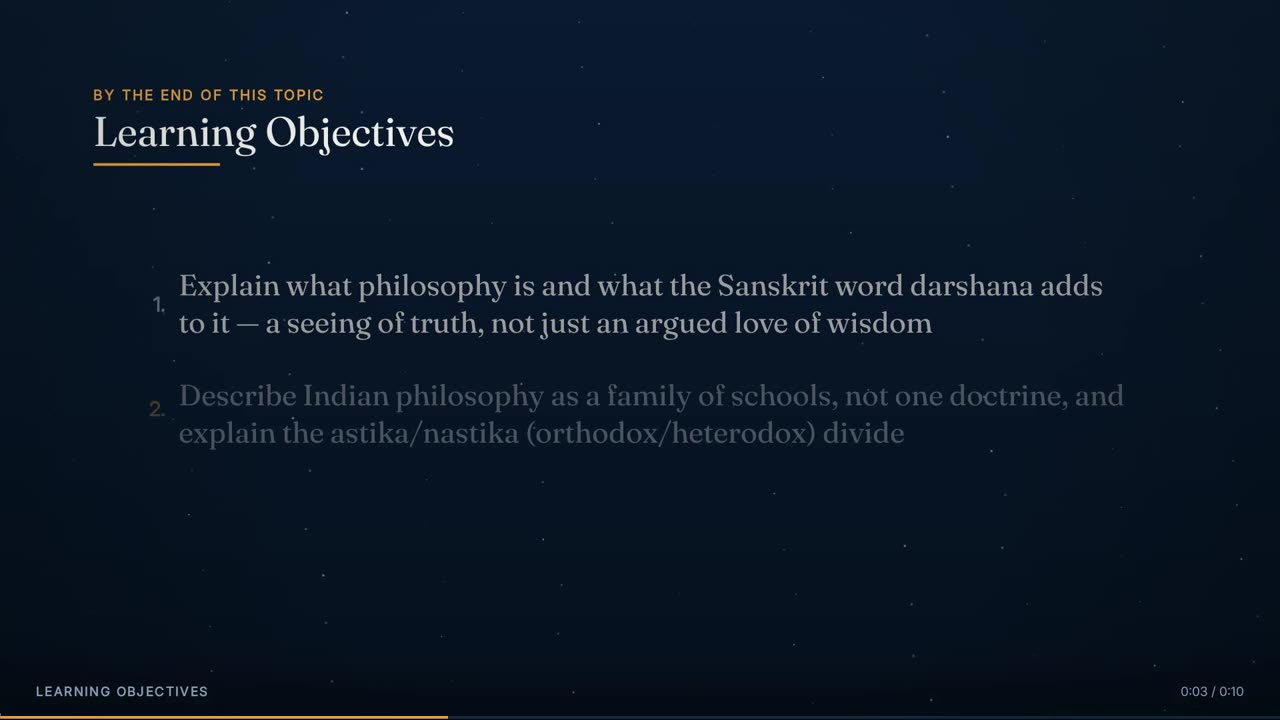
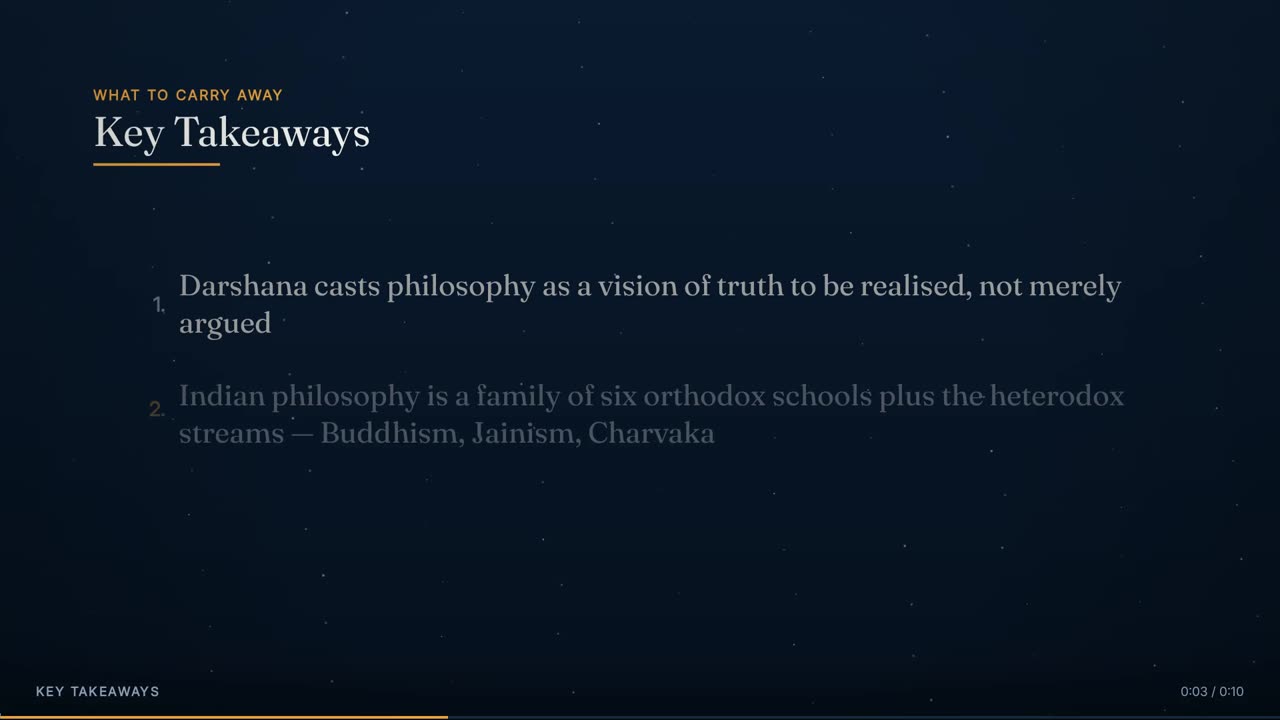
3.5 s: the second objective has just arrived and is current; the first has stepped back to 62%.
03

Current, earlier and settled states

Shows where the reading has got to, then lets go.

Each line has three possible looks. The line that arrived most recently is 'current': full opacity, with its number in the accent colour. Lines that arrived earlier drop back to 62% opacity with their numbers in the muted colour, so the eye goes to the newest statement without losing the old ones. On a silent card, 0.45 s after the last line lands, the list 'settles': with nobody reading, there is no current line, so all three come up to full brightness and the card becomes simply three statements to read in any order. On a narrated card there is no settle — the line being read stays lit.

Anatomy
  • Current: 100% opacity, number in accent colour
  • Earlier: 62% opacity, number in the dim colour (Scholar: #8AA0B6)
  • Settled (silent cards only): all lines 100%, all numbers accent
  • Settle time = last line + 0.45 s (6.45 s on a 10 s card)
Rules
  • Only one line is current at a time
  • Change of state is a colour and opacity change, never a movement
  • Silent cards always settle; narrated cards never do
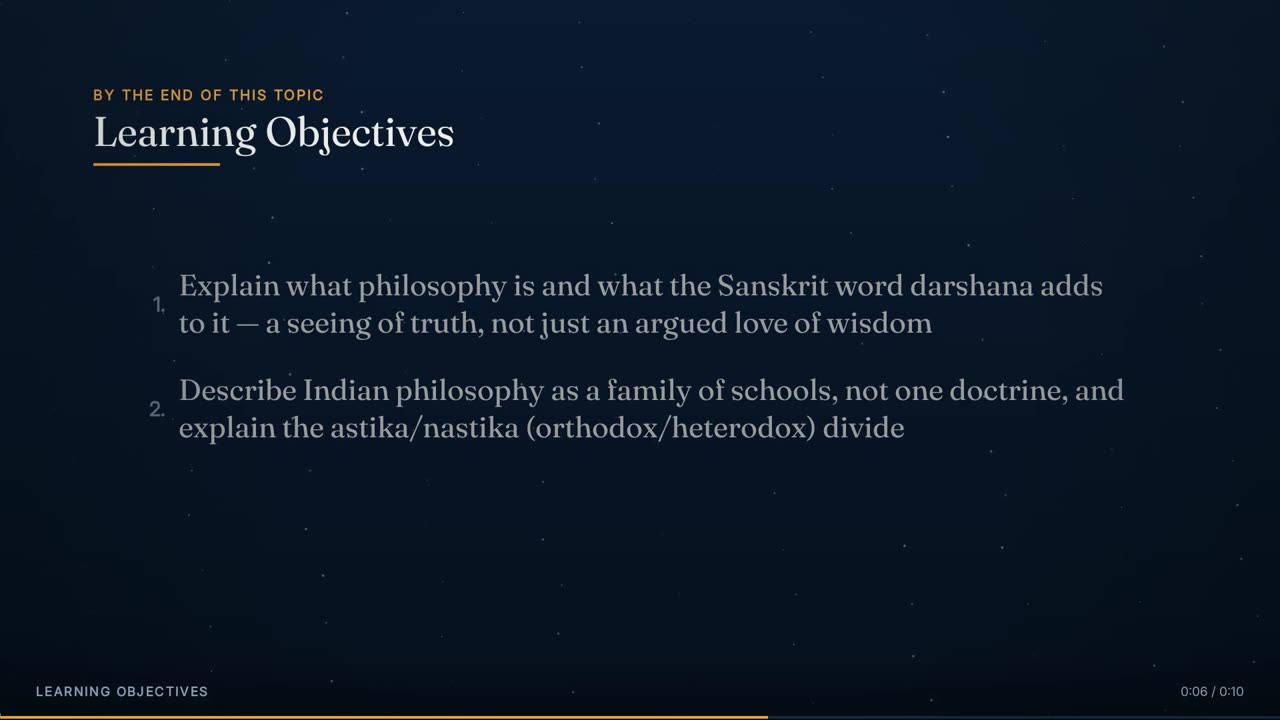
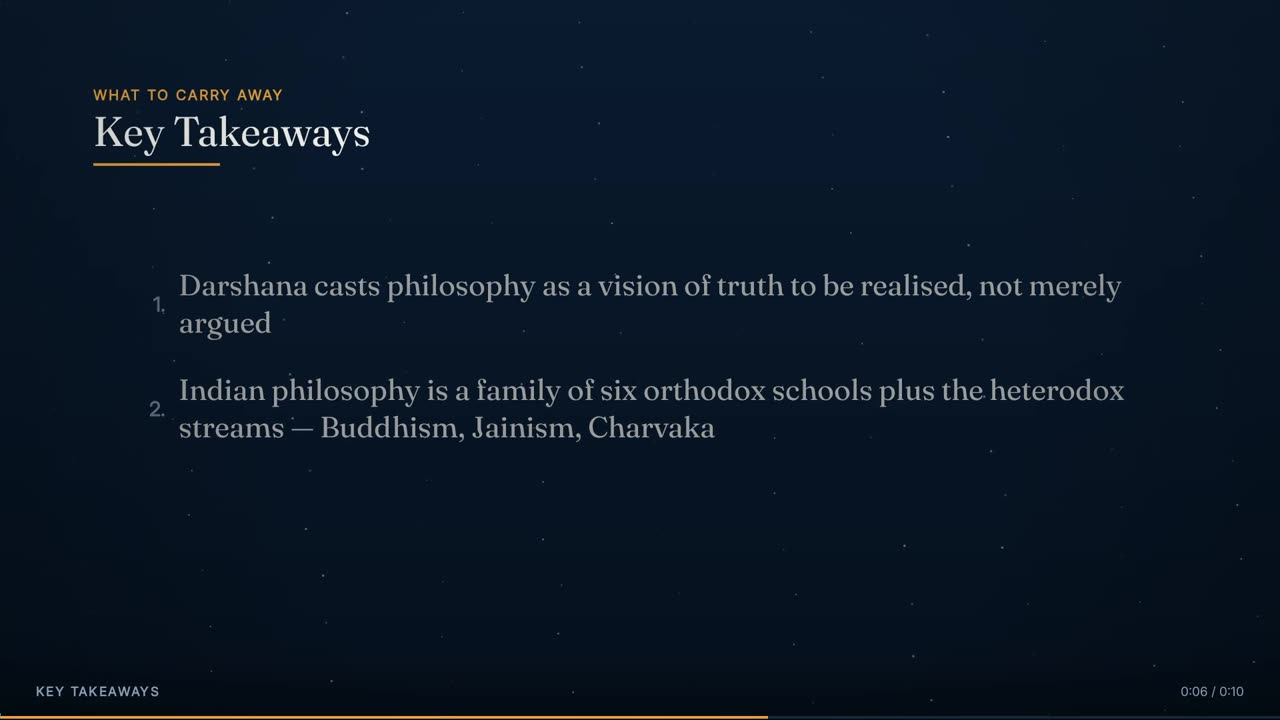
6.0 s: the moment the third objective begins to arrive; the second is still current.
04

The final line and the reading hold

The last line lands with 40% of the card still to run.

The third line is placed so that four tenths of the card remain after it arrives. That time is deliberate: three short statements take roughly that long to read once they are all on screen, and a card that cuts away while the viewer is still reading the last line feels like an error. On a 10-second card the last line arrives at 6.0 s and the viewer then has four seconds with it, three and a half of them with all three lines at full brightness.

Anatomy
  • Lead-in before line 1: 0.9 s
  • Tail after the last line: 40% of the card length
  • Spacing between lines: (length − 0.9 − tail) ÷ 2, never less than 0.6 s of span
Rules
  • Scaled with the card: change 10 s to 14 s and every time moves proportionally
  • No line may arrive in the last 40% of a silent card
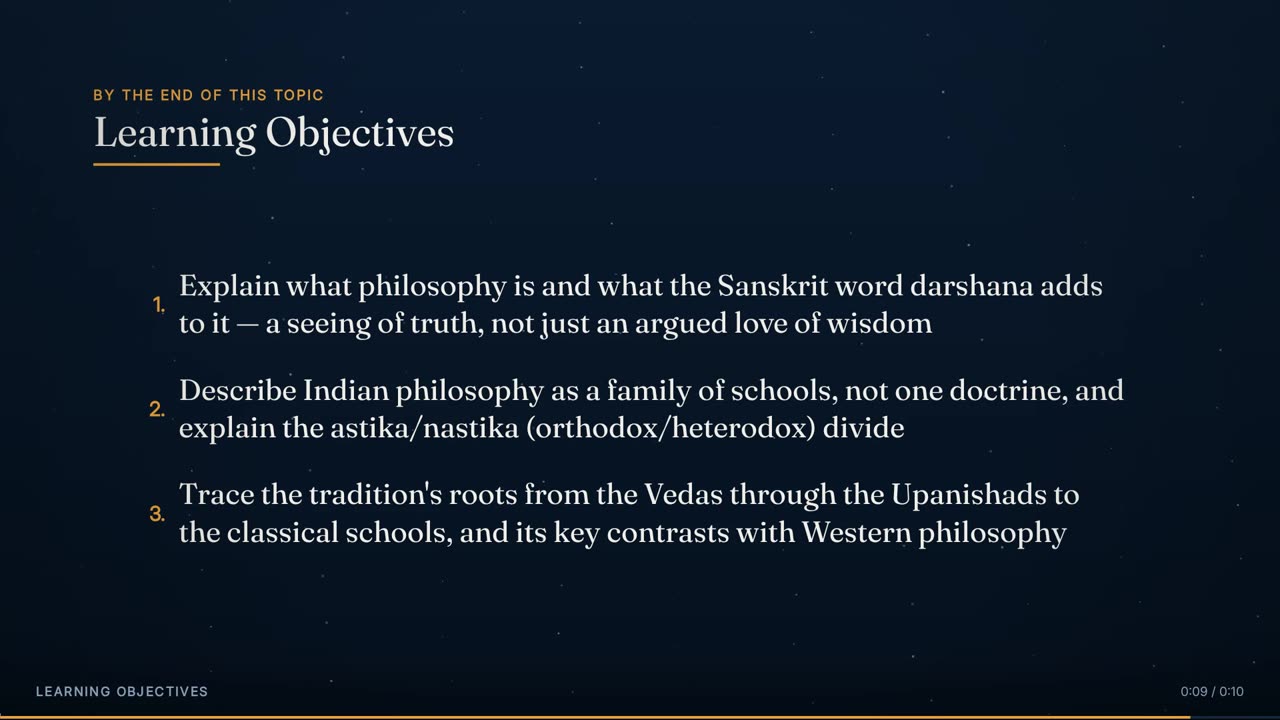
9.3 s: the settled objectives card, all three lines at full brightness.
05

Settled objectives card

What the student reads for the last three and a half seconds.

From 6.45 s to the end of the card all three objectives stand at full brightness under the header, with the bottom chrome showing the scene name and the clock nearly at its end. This is the frame most students will actually read, and the layout is built for it: generous rows, left alignment, a single reading column, nothing competing for attention.

Anatomy
  • All three rows at 100%
  • Starfield drifting behind
  • Clock reads 0:09 / 0:10
Rules
  • Nothing new appears after the settle
  • The card ends on its own length; no line is cut
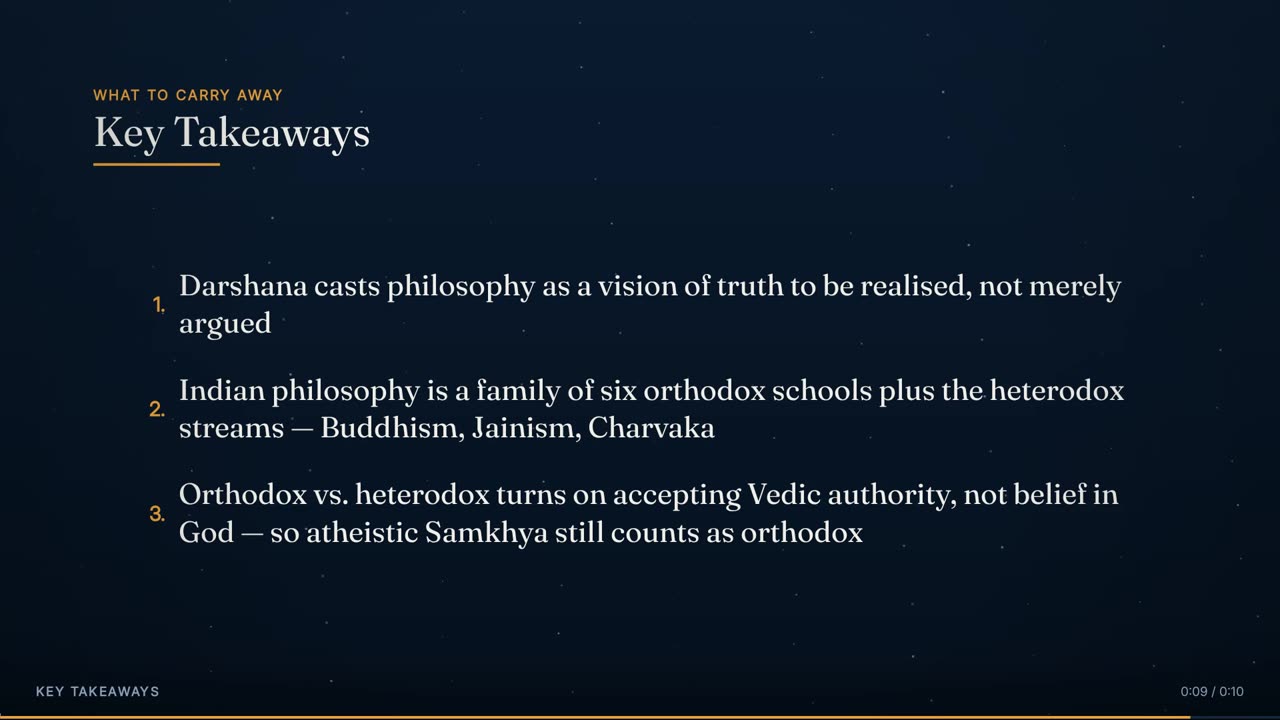
The takeaways card as built for this lecture — the closing ten seconds of the complete film, on the clock with music under it.
06

Key Takeaways card

The same machine at the other end of the film.

The takeaways card is built by exactly the same code as the objectives card, with a different kicker, title, set of lines and window of music. It is the last thing in the complete film, after the end note, so a student who has watched to the end leaves with three statements that echo the three they were promised at the start. Takeaways are written as claims — what the lecture established — where objectives are written as capabilities: 'Explain…', 'Describe…', 'Trace…'.

Anatomy
  • Kicker WHAT TO CARRY AWAY, title Key Takeaways
  • Same geometry, sizes and timings as the objectives card
  • Music from a later window of the track than the objectives card
Rules
  • Three lines, one sentence each
  • Placed last, after the end note
0.4 s into the takeaways card: the dark starfield ground with the header arriving.
07

Starfield ground and vignette

The dark ground both cards sit on.

The cards use the style's dark ground, so they match the dark chapters of the animated lecture. In Scholar that is a deep navy vertical gradient with a slowly drifting field of 150 small stars, each twinkling on its own phase, under a soft radial vignette that darkens the corners. The background keeps moving the whole time, gently enough that it is never something to watch, and the text layer itself never moves once placed — moving text shimmers on screen as its edges re-rasterise.

Anatomy
  • Gradient: #0A1B2E at the top to #05101D at the bottom (Scholar)
  • 150 stars, radius 0.6–1.9 px, pale blue, 55% overall opacity, drifting up to ±9 px horizontally and ±7 px vertically
  • Background clock runs at 0.4× speed
  • Vignette: clear to 560 px from centre, 24% black at 1180 px
Rules
  • The ground belongs to the style: Lattice, Folio, Beacon and Slate each draw their own
  • No camera move on the text layer
9.3 s into the takeaways card: the scene label, the clock at 0:09 / 0:10 and the nearly full progress bar along the bottom.
08

Bottom chrome

Scene label, running clock and progress bar.

Both cards carry the same bottom strip as the animated lecture. The scene name in capitals sits bottom-left, a running clock bottom-right, and a thin progress bar runs the full width of the frame, filling in the accent colour. Because each card is its own piece, the clock and bar describe that card's own ten seconds rather than the position in the whole film — they are there for visual continuity with the lecture, not as a claim about where the student is.

Anatomy
  • Shade: transparent at y=980 to 34% black at the bottom edge
  • Label: interface face 600, 19 px, dim colour, at x=54, y=1044
  • Clock: m:ss / m:ss, 19 px, right-aligned at x=1866
  • Progress bar: 4 px at y=1074, track in line colour at 60%, fill in accent
Rules
  • Clock counts this card's own time
  • Label is the card's title in capitals: LEARNING OBJECTIVES / KEY TAKEAWAYS
The objectives card as built for this lecture — ten seconds, the three lines arriving on the clock, music under it.
09

Music bed

What the student hears under a silent card.

Every card has music under it. If the course supplies a track, the engine measures its tempo and downbeat and cuts each card's excerpt from a different place, starting just before a bar line, so the four framing pieces do not play the same few seconds four times. The short welcome and end note get the gentle opening of the track; the ten-second list cards get its fuller body, found by measuring where the energy actually sits. With no track, a short cue is synthesised: a slow F-major progression of soft pads and a low bass, with a bell note every other bar, through a plate-like reverb.

Anatomy
  • Objectives: first window of the fuller section; takeaways: the next window on
  • Excerpt starts 0.06 s before a downbeat; 0.30 s fade in, 0.90 s fade out
  • Synthesised cue: F – Dm – B♭ – C, 4.6 s per chord, 1.4 s swell in, high-passed at 72 Hz, 42% reverb
  • Music alone levelled to −20 LUFS, true peak −1.5 dB
Rules
  • Excerpts always start on a bar line
  • A card never runs past the end of the track — silence pads it rather than shortening it
  • Music alone sits lower than speech would, because a bed with nothing over it is otherwise the loudest thing in the lecture
3.5 s into the takeaways card as built — on the clock; a narrated card places each line on the words that say it instead.
10

Narration (optional)

A generated narrator reading the card aloud.

When a course wants the cards spoken, the voice model reads a short lead-in and then each line. The lead-in is spoken but not shown: 'Before we begin, here is what you will be able to do by the end of this topic' on the objectives card, 'Before we close, here are the three ideas worth carrying out of this session' on the takeaways card. An explicit 0.7-second pause goes before every line, because commas are compressed unpredictably by the voice model and an explicit pause is not, and the whole read is slowed to 0.88×. If a particular voice refuses a speed setting the engine falls back to the pauses alone and says so.

Anatomy
  • Script: lead-in, then [0.7 s pause] line 1, [0.7 s pause] line 2, [0.7 s pause] line 3
  • Speed 0.88; stability 0.45; similarity 0.75; speaker boost on
  • Audio converted to 48 kHz mono and levelled to −16 LUFS
  • Card length = read length + 0.8 s
Rules
  • The narration is generated from the same text on screen, so what is read and what is shown cannot disagree
  • The lead-in carries no claim of its own; it is the only spoken text not on screen
  • Once generated, the audio can be supplied again without calling the voice model
6.0 s into the takeaways card: the moment the third line is due. In this build the times came from the clock; narrated, they come from the transcript.
11

Line timing from the transcript

How a narrated line knows when to appear.

A narrated card is transcribed with the same speech recognition as the lecture, giving every spoken word a start and end time. The engine takes the first four words of each line, strips punctuation and case, and looks for them in the transcript, searching only after the previous line's match plus 0.2 s so lines can never collide or swap. The line appears on the first of those words. If a phrase cannot be found, the line is placed 1.5 s after the previous one rather than left unshown.

Anatomy
  • Anchor: first four words of the line, trailing punctuation removed
  • Search floor: previous match + 0.2 s
  • Miss: previous point + 1.5 s
  • List starts drawing 0.6 s before the first line
Rules
  • Lookups advance left to right only
  • Only the start of each line is needed — no per-word highlighting on the list itself
12

Caption band (narrated cards)

The spoken words, lit as they are said.

On a narrated card the transcript is also broken into short phrases — at most nine words, split at punctuation or at any pause longer than 0.42 s — and drawn in the lecture's caption band along the bottom of the frame, with the word being spoken highlighted. This carries the lead-in, which is not otherwise on screen, and keeps the card accessible to a student watching without sound. Silent cards have no transcript and so no band.

Anatomy
  • Band centred at y≈950, up to 1500 px wide
  • Interface face 600, fitted from 48 px down to 30 px
  • Current word on an accent-coloured pill; spoken words full ink; words still to come at 40%
Rules
  • Phrases: ≤9 words, break on . , ; : ? or a gap over 0.42 s
  • Present only when there is narration
13

Narrator matched to the presenter

Which of two voices reads the card.

The narrator is a generated voice, not the presenter's own; the engine does not clone anyone's voice. What it does match is register. There are two narrators, one lower and one higher, and the one used is the one that fits the presenter the welcome card names and shows. If the course sheet states it, that decides. If not, the engine measures the recording: the median pitch of every voiced moment, found from the spacing of the voice's harmonics, which stays reliable even when a lapel microphone has thinned out the fundamental. Below 160 Hz reads as the lower voice, above it the higher.

Anatomy
  • Pitch search band 70–320 Hz; 50 ms windows every 25 ms
  • Frames quieter than 0.8× the recording's average level are skipped
  • At least 200 voiced frames needed to decide
  • Split at 160 Hz; references measure 115 Hz and 213 Hz
  • Within 15 Hz of the split, the build flags it for a listen
Rules
  • A stated voice always wins over the measurement; the measurement is then printed as a cross-check, with a warning if they disagree
  • With neither a statement nor a measurement the build refuses to guess — a mismatched narrator is worse than a stopped build
  • A silent build never needs a narrator chosen

Rules

The rules, and the reason for each.

Hard rules are checked by the engine and stop delivery if they fail. Guides steer the choice but can give way when the lecture needs it.

TypeRuleWhy
GuideExactly three lines per card, one sentence each.Three is what a student can still repeat at the end of a lecture; a list of six read aloud is a list nobody carries out of the room.
HardThe lines come from the course sheet; there is no default and no fallback.What a student should be able to do cannot be guessed from a topic's title, and a generic objective on a real lecture is worse than a stopped build.
GuideObjectives are capabilities; takeaways are claims.'Explain…', 'Describe…', 'Trace…' says what the student can do; a takeaway says what the lecture established. Pairing them lets the close echo the opening.
GuideSilent by default, with music under it.Nobody on camera says these lines, and a read card has to last as long as the reading: five seconds becomes seventeen.
HardEach card has a fixed length and its beats are fractions of it.Changing a card from 10 s to 14 s re-times it instead of breaking it; nothing has to be adjusted by hand.
HardThe first line arrives 0.9 s in; the last with 40% of the card left.A short lead lets the header land first; the tail is roughly the time needed to read three short statements.
HardA line is not drawn before its time.The card fills in step with the clock or the voice, rather than standing complete from the first frame.
HardOnce a line arrives it stays until the card ends.Retiring a line would take away something the student may still be reading.
GuideEarlier lines step back to 62%; the newest is full brightness.The eye goes to the newest statement without losing the others.
GuideOn silent cards every line comes up to full 0.45 s after the last arrives.With no one reading there is no 'current' line; the card becomes three statements to read in any order.
HardNarration is generated from the on-screen text.The audio and the screen then cannot disagree, which removes the need to align a free-form script.
GuideThe spoken lead-in is the only narrated text not on screen.It is a framing device with no claim in it; everything that makes a claim is on screen.
GuideExplicit 0.7 s pauses between lines, and a 0.88× read.The voice model runs a list at conversational pace, which is too quick for something being read off the screen at the same time; commas get compressed unpredictably, explicit pauses do not.
HardNarrated lines are found left to right from the transcript.Advancing the search past each match stops two lines landing on the same moment or swapping order.
HardThe narrator follows the presenter's register; a stated choice beats a measured one.A narrator of the wrong register cutting into a lecture is a seam every student notices, and the presenter the card names is who the student takes the lecture to be by.
HardNo narrator, no guess.If the voice cannot be stated or measured the narrated build stops, because a mismatched narrator is worse than no card.
HardMusic excerpts start on a bar line and each card gets a different window.A bed that starts mid-bar sounds like a mistake, and four cards sharing the same few seconds sound like a loop.
HardMusic alone is levelled lower than speech: −20 vs −16 LUFS.At a speech level, a bed with nothing over it would be the loudest thing in the lecture.
HardRendered frame by frame in the lecture's own renderer and style.Every frame shows exactly what the timeline asks for, and the cards look like part of the same film rather than an insert.
HardFonts come from the job, never from the network, and a missing font fails the build.A slow or blocked font request can change timing or silently render thousands of frames in a fallback face.
HardPieces are joined only if they share frame size, pixel format and frame rate.Joining mismatched pieces would reframe one of them; the join refuses instead.
HardThe joined film must be within 0.35 s of the sum of its parts.A dropped or mis-timed piece shows up as a length difference; the build stops rather than deliver it.

Settings

Every setting, with its value.

These are the values the engine runs with today. The name in small type is the setting as it appears in the engine, for anyone comparing notes with a producer.

SettingValueWhat it does
Card lengthseconds10.0 s (objectives and takeaways)How long each silent list card runs. Can be overridden per card; everything inside re-times to fit.
Lines per card3The shape the cards are built for. Other counts render with a warning.
Lead before first line0.9 sTime for the header to land before the first line arrives on a silent card.
Reading tail40% of card lengthHow much of a silent card is left after the last line lands (4.0 s on a 10 s card).
Settle delaysettlelast line + 0.45 sWhen all lines come up to full brightness on a silent card.
List pre-roll0.6 sThe list element starts drawing this long before its first line.
Earlier-line opacity62%How far a line steps back once a newer one arrives.
Line text sizesize44 px, fitted down to 22 pxTarget size for each line, reduced a pixel at a time until the line fits its row.
Header title size62 px, fitted down to 30 pxDisplay size of Learning Objectives / Key Takeaways.
Entrancemotion.enter / motion.rise0.45 s, ease-out cubic, 16 px rise (Scholar)The style's standard arrival; the header uses it slightly slowed, lines with three-quarters of the rise.
Narration speedSPEED0.88×A read slow enough to follow off the screen at the same time.
Pause between linesBREAK0.7 sExplicit pause inserted before each line in the narration script.
Narrator modelMODELthe voice model's multilingual modelWhich generation model reads the script, chosen for quality over speed.
Voice characterstability 0.45, similarity 0.75, style 0, speaker boost onHow even and how close to the chosen voice the read is.
Narrated card tailread length + 0.8 sHow long a narrated list card holds after the last word.
Phrase anchorfirst 4 words of each lineWhat is looked up in the transcript to time a narrated line.
Missed-anchor fallbackprevious + 1.5 sWhere a narrated line goes if its words cannot be found.
Voice splitSPLIT_HZ160 HzMedian pitch dividing the lower and higher narrator.
Pitch bandLO, HI70–320 HzThe range in which a speaking voice's fundamental is searched for.
Voice overrideLECTURE_VOICE_IDunsetAn explicit narrator that wins over both the stated and the measured choice.
Music-only loudness−20 LUFS, true peak −1.5 dBLevel of a silent card's bed.
Narrated loudness−16 LUFS, true peak −1.5 dBLevel of the voice-plus-music mix.
Music duckabout −11 dB under full voice; 20 ms attack, 550 ms releaseHow far the bed drops when the narrator speaks, and how quickly it returns.
Bed level under voiceLEVEL0.22The music's level relative to the voice (at 0.92) before ducking.
Excerpt fadesFADE_IN, FADE_OUT0.30 s / 0.90 sFade applied to each music excerpt.
Downbeat pre-rollPRE0.06 sA breath before the bar line so the first transient is not clipped.
Frame rateFPS30Frames rendered per second of card.
Join toleranceTOL0.35 sHow far the complete film may differ from the sum of its pieces.

Checks

What is verified before it ships.

Lines present

Both lists must exist in the course sheet row; a missing list stops the build with a message naming the field.

Line count

Anything other than three lines is flagged in the build output.

Narrator chosen

A narrated build needs a stated voice, a measurement, or an explicit override; otherwise it stops. Stated and measured choices that disagree are printed.

Borderline pitch

A measured pitch within 15 Hz of the 160 Hz split is flagged to be checked by ear.

Fonts and images loaded

The renderer loads the style's fonts and any pictures before the first frame; a missing font fails loudly instead of rendering in a fallback.

Encode succeeded

Every conversion, levelling and encode step is checked, and a failure stops the build with the error rather than leaving a half-made card.

Pieces share a shape

Before the join, all five pieces are probed for frame size, pixel format and frame rate; any mismatch is listed and the join refuses.

Join length

The complete film's duration is compared with the sum of the pieces and must be within 0.35 s.

Worked example

In a real lecture

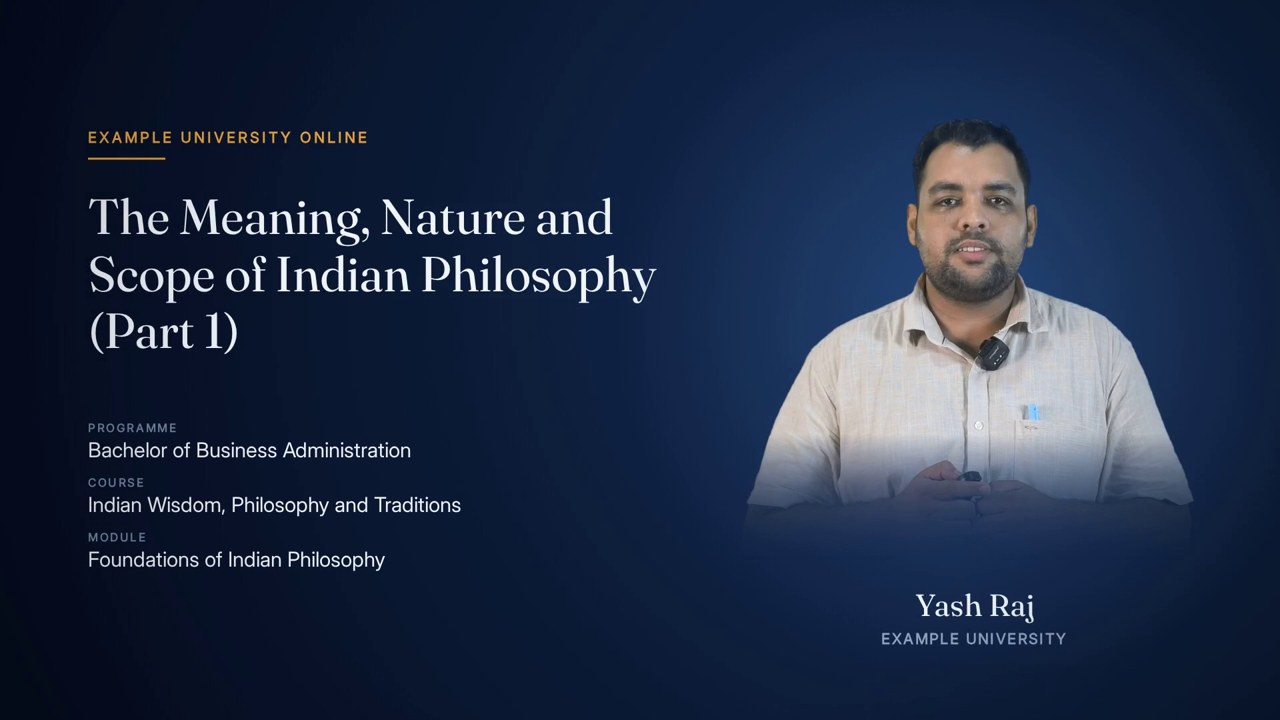
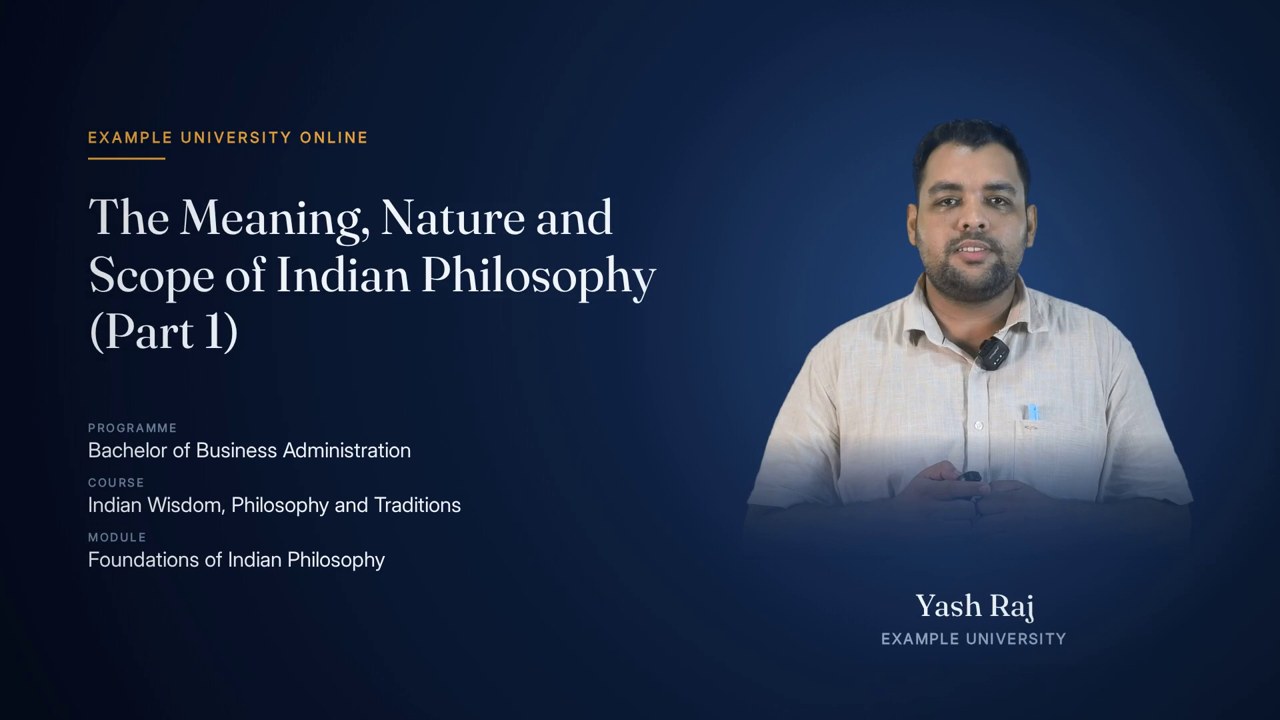
The lecture 'The Meaning, Nature and Scope of Indian Philosophy (Part 1)' — the first topic of a Bachelor of Business Administration course, Indian Wisdom, Philosophy and Traditions — was built in the Scholar style. Its course sheet row carried three objectives and three takeaways.

The objectives: explain what philosophy is and what the Sanskrit word darshana adds to it — a seeing of truth, not just an argued love of wisdom; describe Indian philosophy as a family of schools, not one doctrine, and explain the astika/nastika divide; and trace the tradition's roots from the Vedas through the Upanishads to the classical schools, with its key contrasts with Western philosophy. These are long for a single line, and the renderer fitted them by wrapping within each 157-pixel row rather than letting any overflow.

The takeaways answer them one for one: darshana casts philosophy as a vision of truth to be realised, not merely argued; Indian philosophy is a family of six orthodox schools plus the heterodox streams — Buddhism, Jainism, Charvaka; and orthodox versus heterodox turns on accepting Vedic authority, not belief in God, so atheistic Samkhya still counts as orthodox.

Both cards were built at the default ten seconds on the clock, with music under them. Their cue sheets show the lines arriving at 0.9 s, 3.45 s and 6.0 s, the list starting to draw at 0.3 s and settling to full brightness at 6.45 s. In the complete film the objectives card follows the five-second welcome, so the lecture proper starts at 0:15, and the takeaways card closes the film after the end note.

ScholarStyle
10.0 s, 3 linesObjectives card
10.0 s, 3 linesTakeaways card
0.9 / 3.45 / 6.0 sLine arrivals
6.45 sSettle
0:15 in the complete filmLecture starts at
about 22 min 52 s including all four framing piecesComplete film

Limits

What it deliberately does not do.

  • It does not write the objectives or takeaways. They come from the course sheet; the engine will not invent or guess them.
  • It does not summarise the lecture automatically into these lines; if the lecture has a closing recap, that recap is the natural source, but a person puts it in the sheet.
  • It does not use the presenter's own voice. A narrated card is read by a generated narrator chosen to match the presenter's register, not a copy of the presenter.
  • It does not narrate by default. Narration is switched on per build.
  • It does not hold more than three lines comfortably; more will render but in smaller type, with a warning.
  • It does not show the card's position within the whole film — the clock and progress bar count the card's own seconds.
  • It does not highlight words inside the list lines; the only word-by-word highlighting is in the caption band on narrated cards.
  • It does not place these cards anywhere but the fixed positions: objectives after the welcome, takeaways at the very end.

Works with

How it meets the other effects.

Questions

What educators ask about it.

Who writes the objectives and takeaways?

You do, or whoever prepares the course sheet. They sit in the lecture's row next to the course, module and topic. If a lecture has its own closing recap, that is usually the best source for the takeaways, and each objective is the matching takeaway restated as something the student can do.

Why only three?

Because three short lines are something a student can still repeat at the end of the lecture. Longer lists get read and forgotten. The engine will render a different number, but it warns you, and the type gets smaller.

Can the cards be narrated?

Yes. Narration is an option per build: the on-screen text is read by a generated narrator at a slightly slowed pace, with a pause before each line, and each line appears as it is read. By default the cards are silent with music, which keeps them to ten seconds each.

Is the narrator the presenter's voice?

No. It is a generated narrator, and the engine does not copy anyone's voice. It picks between a lower and a higher narrator to match the presenter — from the course sheet if you state it, otherwise by measuring the pitch of the recording.

Can the cards be longer or shorter?

Yes. The length is a single number per card. The timing inside is worked out as fractions of that length, so a 14-second card simply spaces the lines further apart and keeps the same proportion of reading time at the end.

Will the cards match our lecture's look?

They are drawn by the same renderer, in the same style, fonts and palette as the rest of the lecture, so a change of style changes the cards too.

All effects

Every effect has a page like this one.

See this effect on your own lecture.

Send a recording and we'll run it through the pipeline as a pilot — one free sample per institution.