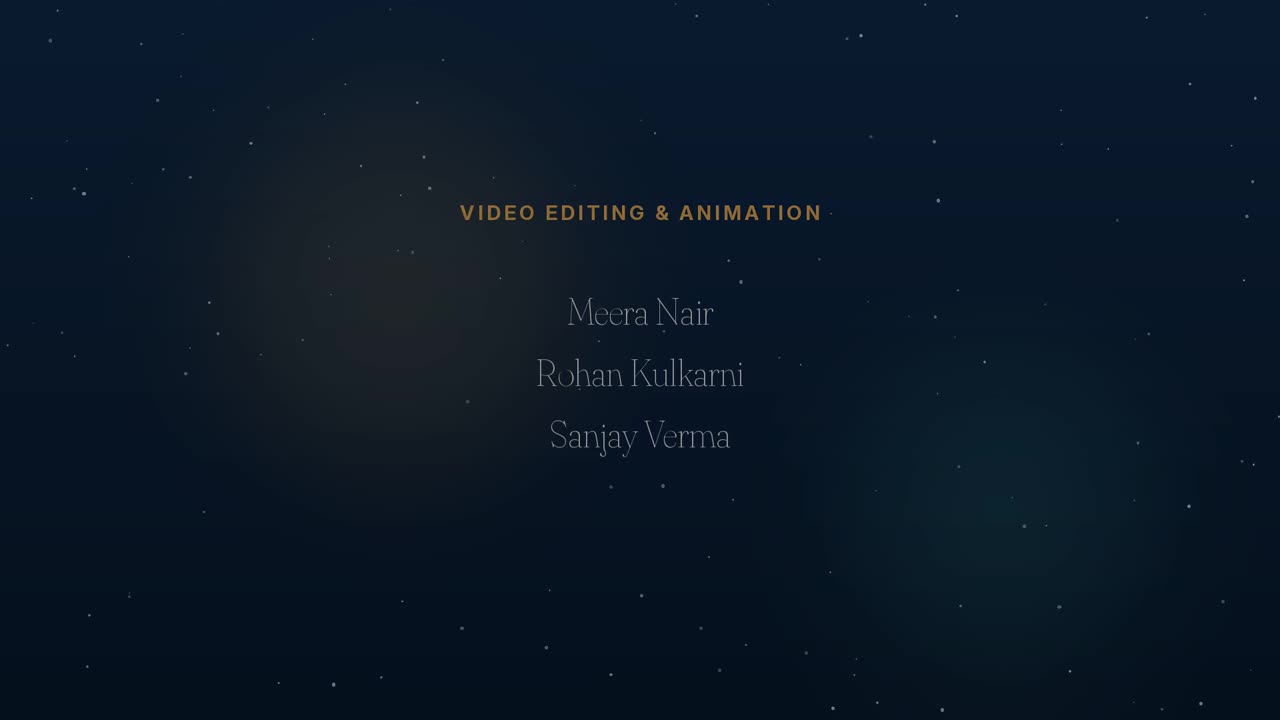
| Hard | This is the one segment built to name people and an institution. | The lecture body is kept unbranded so it can be reused; branding is added downstream, in segments of its own. |
| Hard | Names must not appear in the lecture body. | If a name shows up between the opening and closing cards, something upstream has leaked branding into a segment meant to be reusable. |
| Hard | The style is matched to the film, never re-picked. | A credits sequence in a different style looks like it belongs to a different film. |
| Hard | It extends past the film's last card; it does not replace it. | The closing card is part of the film; the credits are an addition to it. |
| Hard | Fixed order: identity, editing and animation, technical team, copyright. | Who made the lecture's content comes first, the people who produced it next, the sign-off last. |
| Guide | Identity is one combined card unless one fact is unusually long. | Three short related facts read better together; a long course name must not shrink the presenter's name. |
| Guide | The university on the identity card is the least prominent of the three facts. | It is repeated in the copyright line, and the person and course are what the student is being introduced to. |
| Hard | Every team list is measured in full before drawing. | A team of two and a team of twelve must not share a font size, and a guess lets the longest name clip. |
| Guide | Long lists wrap into two or three columns. | One name per line stops fitting well before a dozen names. |
| Guide | Each block holds about 3–4 s; long lists hold longer. | These are names read for the first time, not a list the viewer has already half seen; the eye needs time to read, not just to register a list. |
| Guide | The copyright line is the quietest card and is held longest. | It is the sign-off and the last thing on screen before black. |
| Guide | The university appears twice, on purpose. | Once as identity, once in the sign-off; removing the second as a duplicate breaks the copyright line. |
| Hard | The same dark ground as the closing cards, still moving. | The sequence should read as the continuation of the close, and a suddenly static background looks like a freeze. |
| Guide | The style's own entrance, about 0.45 s with a 12–20 px rise. | The credits move the way everything else in the film moves. |
| Guide | Cross-fade of about 0.8 s at each block change. | It is the same boundary the lecture uses at every scene change. |
| Guide | Silent, or the music tail ramped to true silence over the final ~2.5 s. | There is nothing to synchronise to, and the film must not end on an abrupt audio cut. |
| Hard | No sound effects in the credits. | Sound design cues are tied to visual events in the lecture; a still card has none. |
| Hard | End on a fade to black. | A hard cut from a held card reads as a truncated file. |
| Hard | A name that has not been settled is left off rather than guessed. | As everywhere in the engine, an honest card with no name is better than a card with the wrong one. |
| Hard | Delivered at the film's own shape: 1920×1080, 30 fps. | Pieces that differ in size or frame rate cannot be joined without reframing one of them. |