Engine/Effects/Pre-Processing

Studio Sound

Studio Sound restores the lecturer's voice. It removes the room noise a lecture theatre leaves behind, cuts the boxiness of a clip-on microphone, gives back some of the top end the microphone lost, and levels the whole lecture to a steady −16 LUFS with true-peak headroom. Every step is measured before and after, and a stage is left out when the measurement shows the problem is not there.

Measure · denoise · shape · level to −16 LUFS

The finished effect

What it looks like when it is done.

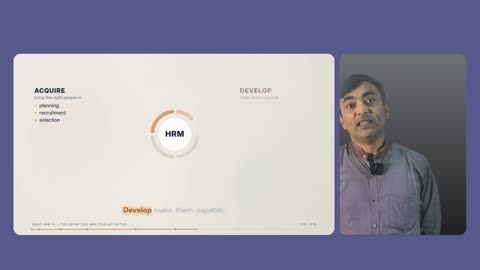
The same passage before and after Studio Sound. Play it with headphones or speakers: the room noise drops away, the voice sits at a steady broadcast level, and nothing about the delivery changes.

18 s · 1920 × 1080 · with sound

Overview

What it is, and why it exists.

A lecture recorded in a real room carries the room with it: air conditioning, a projector fan, preamp hiss, the low-mid build-up of a microphone clipped under a shirt collar, and a level that rises and falls as the lecturer leans in and away. None of it stops a student hearing the words. All of it makes a produced course sound like a recording of a classroom rather than a course.

Studio Sound runs second, straight after Video Cleanup and before every other effect. The order is causal. Cleanup decides what is in the take and Studio Sound decides what it sounds like, and it profiles the room's noise from the take itself. Run first, it would profile silence that is about to be cut and describe a room the finished film never contains.

It is restorative, not creative. It never changes what was said, never re-times anything (its output must match the cut voice track's length to within 20 milliseconds) and never adds music or sound effects. It produces one file, the restored voice track, and every later effect carries that file: the animated lecture, both presenter layouts, every cutaway, and the finished film, which lays it under the picture once at the end.

Its rule is to decide from numbers, not by ear. Nobody can judge their own processing after twenty minutes of listening, and a lecture recording has nothing to compare against. So the noise floor, speech level, signal-to-noise ratio, spectrum, hum, clipping and level spread are all printed before a filter is written, and again after every stage.

−16 LUFS integratedLoudness target
−1.5 dBTPTrue-peak ceiling
7 LULoudness range target
about 12 dB, never 30Noise reduction
the quietest 80 × 0.4 s of this take (32 s)Noise profile
7 bands, 75 Hz to 7.5 kHzVoice EQ
under 0.02 sLength change allowed
+7.0 dB (16.6 → 23.6 dB)SNR gain on the sample lecture

How it is made

Step by step, in the order the engine runs it.

Take the cut voice track

The input is the voice track Video Cleanup produced: mono, 48 kHz, cut to the plan with 20 ms fades at every join, and otherwise exactly as recorded. A stereo input is folded to mono first. Nothing else is needed: no script and no finished render.

Measure everything first

The track is sliced into 0.4-second windows. The noise floor is the RMS level of the 3rd-percentile window, the speech level is the 85th percentile, and the gap between them is the signal-to-noise ratio, the most useful single number in the pass. The same measurement also reports peak level, samples at full scale grouped into runs, DC offset, octave-band energy of noise and speech separately, narrow peaks at 50, 100, 150, 200, 60 and 120 Hz against their neighbours, spectral balance, sibilance, and the spread of 3-second levels across the whole lecture.

Repair only what is broken

Full-scale samples are counted and grouped before any decision about clipping. Isolated runs of a few samples are the peak grazing full scale. They cannot be heard, and a de-clipper would replace real signal with interpolation for no benefit, so de-clipping is not run. The real peak problem is inter-sample overshoot, which the limiter and true-peak target handle at the end of the chain. Mains hum is notched only if a harmonic stands more than 9 dB above its neighbours. DC offset matters only above ±0.001, and the high-pass removes it anyway.

Profile the room from this take

The 80 quietest 0.4-second windows, 32 seconds of material, become the noise profile. A generic preset would remove the wrong thing. Because cleanup has already trimmed long silences and cut the lead-in and tail, these windows come from real gaps between words in the lecture that will actually ship.

Subtract the noise, conservatively

Spectral noise subtraction reduces the profiled noise by 75% of its amplitude, about 12 dB. The mask is smoothed across 400 Hz of frequency and 64 ms of time, in 2048-point frames with a 512-sample hop. Unsmoothed masks cause the watery, swirling artefacts on breaths and sibilants that students notice far more than a quiet room tone. A lecture that sounds slightly roomy is fine; one that sounds underwater is not.

Shape the voice: cut before you boost

A high-pass at 75 Hz removes desk rumble, footsteps and air handling. Three cuts take out the boxiness of a clip-on microphone: 2 dB at 180 Hz, 3.5 dB at 380 Hz and 1.5 dB at 900 Hz. A 3 dB lift at 3.2 kHz adds presence and intelligibility. A 4.5 dB high shelf from 7.5 kHz restores some of the air a lavalier under clothing loses, and a narrow 1.5 dB cut at 6.2 kHz keeps that lift from turning harsh. The shelf comes after the denoise, or it would simply amplify hiss.

Hold the pauses down

A downward expander runs before any compression. It leaves everything from −24 dBFS upwards alone, pushes −34 dBFS down to −41 and −42 dBFS down to −62, with a 6 dB soft knee, a 20 ms attack and a 250 ms release so word tails are not chopped. Without it, the compressor's make-up gain lifts the residual noise between words straight back up and undoes the noise subtraction. On a measured lecture this one stage was worth 10 dB of final signal-to-noise.

Level, limit, normalise

Gentle compression at 2:1 above −20 dBFS, with a 12 ms attack, 220 ms release and 3.5 dB of make-up, evens out a leaned-in sentence against a trailing one. A limiter at about −1 dBFS (5 ms attack, 60 ms release) catches remaining transients. Loudness normalisation then sets the whole lecture to −16 LUFS integrated, a −1.5 dBTP true-peak ceiling and a 7 LU loudness-range target. −16 LUFS is the spoken-word and e-learning convention, and suits both a phone speaker and a lecture-hall PA.

Measure again and hand over

The finished track is measured with the same windows as the source, then run through a full loudness meter for integrated loudness, loudness range and true peak. It is written as mono 48 kHz 16-bit audio. The job doctor then confirms it is the same length as the cut voice track to within 0.02 s. From then on, every effect and the finished film use this file and never the recording's own sound.

Elements

Everything this effect puts on screen, one piece at a time.

Each element below is shown as the engine actually produced it, in the real lecture, with its parts, and the rules that govern it.

Before — the raw recording
Twelve seconds of the lecture as recorded, at 6:43 in the raw take.
01

Cut voice track (input)

The lecture's sound after cleanup and before restoration.

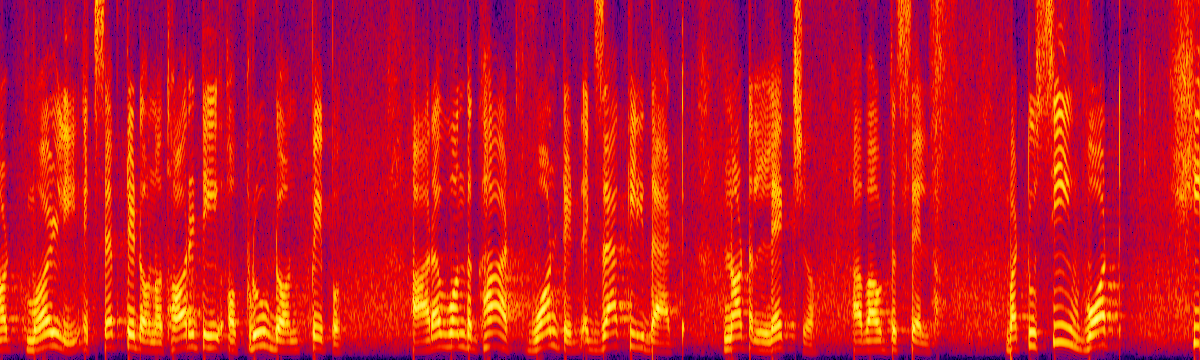
This is what Studio Sound starts from: the voice track cut to the cleanup plan, with 20 ms fades at every join and nothing else changed. It holds everything the room contributed. In this lecture that meant a noise floor at −32.4 dBFS, a 250–800 Hz band 14.6 dB above the rest of the voice, and top end falling away to −17.8 dB between 10 and 16 kHz. Working on the cut track rather than the raw recording means the room is profiled from the take that ships, and no processing time is spent on material that was thrown away.

Anatomy
  • Mono, 48 kHz, 16-bit
  • Length exactly equal to the sum of the kept stretches
  • No noise reduction, EQ or levelling yet
Rules
  • Never the raw recording: the cuts come first
  • A stereo source is folded to mono before measurement
Spectrogram of 12 seconds as recorded, 0–8 kHz: the gaps between words are filled with broadband room noise, and energy is heavy in the low-mids.
02

Measurement report

The numbers every decision is made from.

Before any filter is chosen, the track is measured, and the same measurement is printed after each stage so the effect of every step is visible as a number. The core is the 0.4-second window. The quietest windows describe the room, the loud ones describe the voice, and the gap between them is the signal-to-noise ratio. Its level tells you whether the recording has a room problem or a microphone problem. The report also shows where the noise sits in frequency, whether mains hum is present, how much of the voice lives in the boxy low-mids, and how steady the level is across the whole lecture.

Anatomy
  • Noise floor: RMS of the 3rd-percentile 0.4 s window
  • Speech level: RMS of the 85th-percentile window; SNR is the difference
  • Clipping: samples at or above 0.999 of full scale, grouped into runs
  • DC offset; octave-band noise vs speech from 20 Hz to 24 kHz
  • Hum: peaks at 50/100/150/200/60/120 Hz against the floor 3–9 Hz either side
  • Spectral balance in six bands, 80 Hz–16 kHz; sibilance as 5–9 kHz against 1–4 kHz
  • Level drift: 10th and 90th percentile of 3-second RMS, ignoring windows within 12 dB of the floor
Rules
  • Read the numbers before writing a filter. A take with 45 dB SNR, no hum and a 2 dB level spread needs normalisation and nothing else
  • Hum counts as audible above 9 dB over its neighbours; sibilance counts as hot above −8 dB
03

Clipping decision

Counted and grouped, then deliberately left to the limiter.

Samples at full scale look alarming in a count and are usually harmless. What matters is whether they are isolated grazes of a few samples, lasting a tenth of a millisecond or less, or sustained runs lasting tens of milliseconds, which are real distortion. A de-clipper interpolates plausible signal in place of what it replaces, so running one on grazes swaps real audio for a guess. The engine counts the samples, groups them into runs and reports both. The chain itself runs no de-clipper. It deals with the one peak problem that affects delivery, inter-sample overshoot, with the limiter and the true-peak ceiling.

Anatomy
  • Threshold: 0.999 of full scale
  • Runs of 3 or more consecutive samples reported separately
Rules
  • No de-clipping of isolated grazes
  • Sustained clipping cannot be undone by any stage and is reported as a limit of the source
04

Noise profile

A portrait of this room, taken from this lecture's own quiet moments.

The profile is built from the 80 quietest 0.4-second windows of the cut track: 32 seconds of the room with nobody speaking. Because cleanup has already removed the lead-in, the tail and the long pauses, these windows are the short breaths between words in the lecture that will actually be delivered. They contain the air conditioning, fan and preamp hiss as they sound under this lecturer, on this day, through this microphone. A preset profile describes some other room, and removes the wrong thing.

Anatomy
  • 80 windows × 0.4 s = 32.0 s
  • Chosen by lowest RMS across the whole lecture
Rules
  • Profiled from this take, never from a preset
  • The quiet windows should fall in gaps between words. If they land inside speech, the take has a level problem, not a noise problem, and the profile would eat the voice
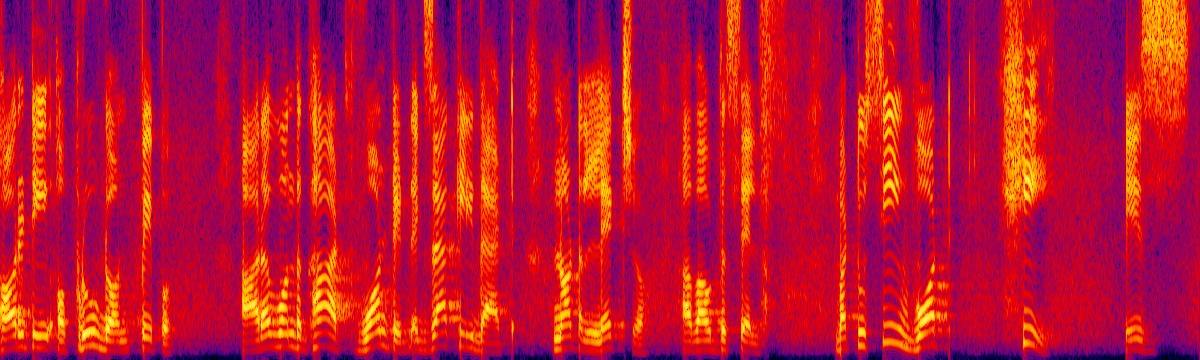
The same 12 seconds after Studio Sound: the room noise between words is gone, the low-mids are thinner and speech stands clear of a dark background.
05

Spectral noise subtraction

Removes the steady room noise by about 12 dB.

The profiled noise is subtracted across the spectrum, frame by frame, as a stationary noise: the room's hum and hiss do not change during a lecture. The reduction is deliberately conservative, removing 75% of the noise amplitude, about 12 dB, rather than trying for silence. Deeper reduction trades noise for musical-noise artefacts, the watery swirl on sibilants and breaths that listeners notice first. The mask is smoothed across 400 Hz and 64 ms so it cannot flicker. On this lecture the stage lowered the floor from −32.4 to −42.2 dBFS and raised the signal-to-noise ratio from 16.6 to 24.0 dB.

Anatomy
  • Stationary subtraction; proportion removed 0.75 (≈ 12 dB)
  • 2048-sample frames and window, 512-sample hop (about 43 ms and 11 ms at 48 kHz)
  • Mask smoothing: 400 Hz in frequency, 64 ms in time
Rules
  • Aim for 8–12 dB of reduction, not 30
  • An SNR gain of 20 dB almost certainly means artefacts: back the reduction off and re-measure
  • Nothing is boosted before the noise in that band has been subtracted
06

Voice EQ

Removes rumble and mud, adds presence, and gives back some air, in that order.

Seven filters, in a fixed order. The high-pass removes everything below the voice. Three bell cuts take out the boxiness that a microphone clipped under clothing piles into the low-mids, and this lecture's 250–800 Hz band measured 14.6 dB above the rest of the voice. A broad lift around 3.2 kHz adds intelligibility, the band that decides whether a student can follow at 1.5× speed on a phone. A high shelf from 7.5 kHz returns some of the air a lavalier loses, and a narrow cut at 6.2 kHz stops that lift turning harsh.

Anatomy
  • High-pass 75 Hz, 2-pole (12 dB per octave)
  • −2.0 dB at 180 Hz, Q 1.0
  • −3.5 dB at 380 Hz, Q 1.1
  • −1.5 dB at 900 Hz, Q 1.2
  • +3.0 dB at 3.2 kHz, Q 0.9
  • +4.5 dB high shelf from 7.5 kHz
  • −1.5 dB at 6.2 kHz, Q 2.0
Rules
  • Cut the mud before adding the air
  • The air shelf goes after the noise subtraction, or it lifts hiss
  • The standard chain carries no de-esser. Sibilance is measured on every lecture, and a de-esser on a source already short of top end would only make it duller
Waveform of the 12 seconds as recorded: the gaps between phrases sit high on the room's noise, and phrase levels vary.
07

Downward expander

Holds the pauses down so compression cannot bring the room back.

This is the stage that is easy to skip and expensive to skip. A compressor's make-up gain raises everything quiet, including the residual noise between words that the subtraction has just lowered. The expander comes first and pushes that quiet material further down. Speech from −24 dBFS upwards passes unchanged. Below that, the curve falls away steeply: −34 dBFS becomes −41, and −42 dBFS becomes −62. A soft knee and a quarter-second release let the tail of each word fade naturally rather than being chopped off.

Anatomy
  • Transfer curve (in → out): −90 → −105, −42 → −62, −34 → −41, −24 → −24, 0 → 0 dBFS
  • Soft knee 6 dB
  • Attack 20 ms, release 250 ms
Rules
  • Always before the compressor, never after
  • Slow enough in release that word tails are not gated
08

Compressor

Evens out a leaned-in sentence against a trailing one.

Gentle compression does not aim at loudness; that comes at the end. It reduces the difference between the lecturer's strongest and weakest delivery so the student does not have to reach for the volume control. At 2:1 above −20 dBFS, a phrase 6 dB over the threshold comes out 3 dB over it. The 12 ms attack lets consonant onsets through before the gain moves, and the 220 ms release recovers between syllables without pumping.

Anatomy
  • Threshold −20 dBFS, ratio 2:1
  • Attack 12 ms, release 220 ms
  • Make-up gain 1.5× (about +3.5 dB)
Rules
  • Levelling, not loudness
  • On a take whose 3-second level spread is under about 3 dB, a lighter ratio would do: the spread is printed so this can be checked
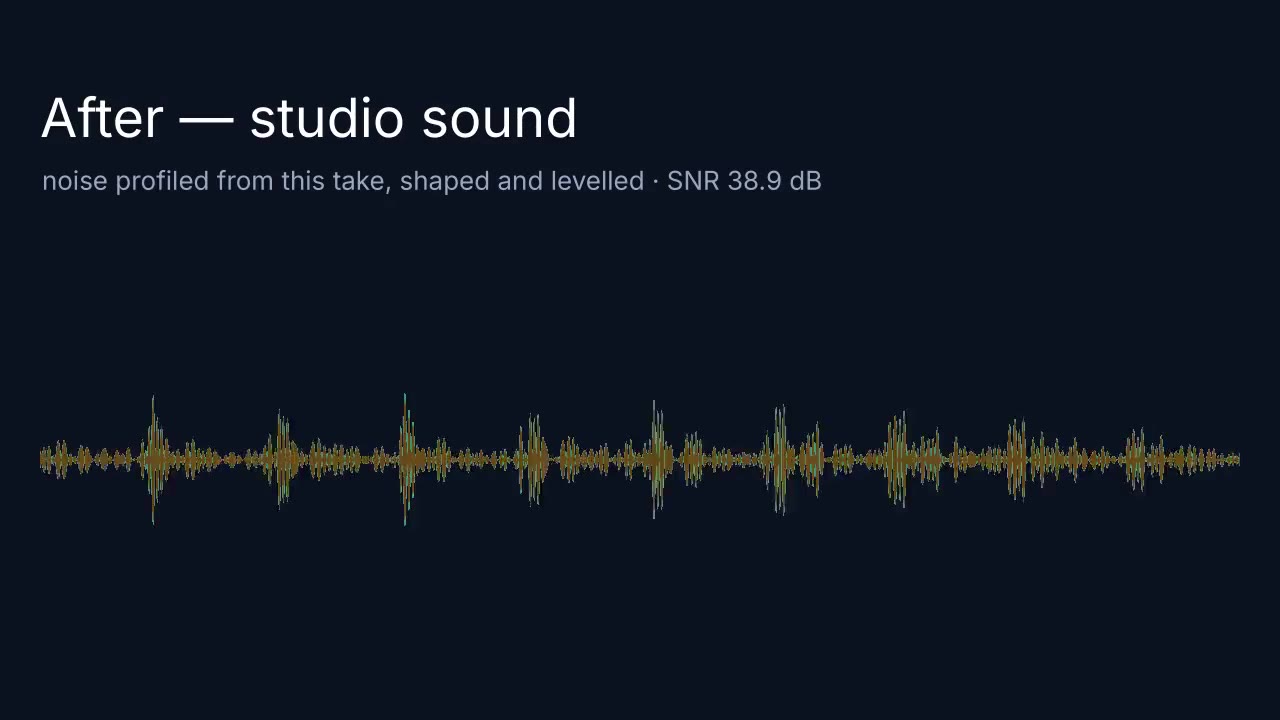
The same 12 seconds after Studio Sound: pauses held down near silence, and phrases levelled to a steady height.
09

Limiter and loudness normalisation

Sets the lecture to −16 LUFS with true-peak headroom.

A limiter at 0.89 of full scale, about −1 dBFS, catches whatever transients remain. A loudness normaliser then brings the lecture to −16 LUFS integrated with a true-peak ceiling of −1.5 dBTP and a loudness-range target of 7 LU. True peak matters because a recording can stay below full scale on every sample and still overshoot between samples. The raw file hides it, and it distorts as soon as the lecture is encoded for delivery. −16 LUFS is the spoken-word convention; −23 LUFS is used only if an institution requires broadcast delivery.

Anatomy
  • Limiter ceiling 0.89 (≈ −1.0 dBFS), attack 5 ms, release 60 ms
  • Integrated loudness −16 LUFS
  • True peak −1.5 dBTP
  • Loudness range target 7 LU
Rules
  • Integrated loudness must land within ±0.5 LU of target
  • The voice is never re-compressed downstream to fit anything else. If music will not sit under it, the music comes down
After — Studio Sound
The same 12 seconds after Studio Sound: the room gone, the voice clearer and brighter, the level steady.
10

Restored voice track

The one audio file every later effect and the finished film use.

The output is a single mono 48 kHz track, exactly as long as the cut voice track, at −16 LUFS. It is not muxed back onto the cleaned picture as a deliverable, because picture and sound travel separately and each effect combines them as it needs to. The finished film lays this track under the assembled picture once, at the very end, so no piece of the film re-encodes or re-levels the voice. The narrator for the objectives and takeaways is also chosen to match the presenter, with this track's measured pitch printed as a cross-check.

Anatomy
  • Mono, 48 kHz, 16-bit
  • −16 LUFS integrated, −1.5 dBTP ceiling
  • Same length as the cut voice track, within 0.02 s
Rules
  • Every effect uses this track, never the recording's own sound
  • Its length may not differ from the cut voice track by 0.02 s or more
11

Before-and-after reference

A thirty-second listening check for a person.

Numbers decide the chain, but a person should be able to confirm the result without opening the whole lecture. So passages are rendered raw and then processed, with at least one containing real pauses, because that is where denoise artefacts on breaths and sibilants show first. Spectrograms and waveforms of the same passage are produced alongside so the change can be seen as well as heard.

Anatomy
  • Short passages, raw then restored
  • At least one passage containing real pauses
  • Matched spectrogram and waveform views
Rules
  • Listen specifically to breaths and sibilants, where artefacts appear first
  • Check at least three 15-second windows spread across the lecture
12

Voice under music (bookends)

How the restored voice sits with music where music is used.

The lecture itself carries the voice alone. Music appears under the four short cards that frame it: welcome, objectives, takeaways and closing note. The objectives and takeaways are narrated, normalised to the same −16 LUFS with a −1.5 dBTP ceiling as the lecture, so the level does not jump at the join. A music-only card sits lower, at −20 LUFS. Where music runs under speech, the voice is the master: the music is ducked by the voice's own envelope, the way a sidechain works, so the voice is never processed to fit the music.

Anatomy
  • Narrated cards: −16 LUFS, −1.5 dBTP
  • Music-only cards: −20 LUFS
  • Music ducked by the voice envelope, not the reverse
Rules
  • If a bed will not sit under the voice, the bed comes down
  • No music or sound design is ever mixed into the restored voice track itself

Rules

The rules, and the reason for each.

Hard rules are checked by the engine and stop delivery if they fail. Guides steer the choice but can give way when the lecture needs it.

TypeRuleWhy
HardStudio Sound runs after Video Cleanup and before every other effect.The noise profile must describe the take that ships. Running it first profiles silence that is about to be cut, and wastes processing on discarded material.
HardEvery decision is made from a measurement, printed before and after.Nobody can hear their own processing after twenty minutes, and a lecture has no reference recording to compare against.
HardRepair only what is measurably broken.Each stage costs some quality. A stage that fixes a problem the recording does not have is pure loss.
HardClipping is counted and grouped before any repair.Isolated grazes are inaudible, and de-clipping them replaces real signal with interpolation. Only sustained runs are real distortion.
HardHum is notched narrowly, never removed with broadband denoising.Broadband reduction aimed at a single tone takes a lot of speech with it. A notch is used only above 9 dB over the neighbouring floor.
HardThe noise profile comes from this recording's own quietest windows.A generic profile removes the wrong thing. This room's air conditioning and this preamp's hiss are specific.
HardNoise reduction is conservative: about 12 dB, not 30.Deeper subtraction produces watery, swirling artefacts that students notice far more than a quiet room tone.
HardThe subtraction mask is smoothed in frequency and time.Unsmoothed masks are what produce the swirl.
HardCut the mud before adding the air, and never boost a band before its noise is subtracted.Boosting first amplifies the noise that lives in that band. The high shelf in particular lifts hiss if it comes before the denoise.
HardThe downward expander comes before the compressor.Compression make-up gain otherwise lifts the residual noise between words back up and undoes the noise subtraction. On one measured lecture the expander was worth 10 dB of final SNR.
GuideCompression is gentle: 2:1 above −20 dBFS.The goal is evening out delivery, not loudness. Heavy compression pumps and brings up breaths.
HardDeliver at −16 LUFS integrated with a −1.5 dBTP true-peak ceiling.−16 LUFS is the spoken-word and e-learning convention for phones and lecture-hall PAs. True-peak headroom stops inter-sample overshoot distorting when the film is encoded. −23 LUFS is used only when broadcast delivery is required, and the report says which was used.
HardStudio Sound never changes the length or timing.Every caption, cue and sync point is timed against the cut. The output must match the cut voice track to within 0.02 s, or the build stops.
HardNothing is added: no music, no sound design, no re-voicing.This is a restorative pass. Music is mixed under the voice elsewhere, and only under the bookend cards.
HardThe voice is never processed to fit something else.If music will not sit under the narration, the music comes down. Nothing downstream re-compresses the voice.
HardEvery later effect uses the restored track, never the recording's own sound.One voice track for the whole film means one loudness, one tone and no seams between layouts.
GuidePicture and restored sound travel separately.The restored track is not muxed back over the cleaned picture as a master. The finished film lays it under the assembled picture once, at the end.
GuideAn SNR gain under about 4 dB is reported as the pass not earning its place.Shipping processing that did not help is worse than saying so.
GuideWhat the source cannot give is stated, not faked.Missing frequencies, sustained clipping, overlapping voices and long reverb cannot be restored by processing. Pretending otherwise produces something polished and wrong.

Settings

Every setting, with its value.

These are the values the engine runs with today. The name in small type is the setting as it appears in the engine, for anyone comparing notes with a producer.

SettingValueWhat it does
Measurement window0.4 sThe slice all floor, speech and profile measurements are made on.
Noise-floor percentile3rdThe window level taken as the room's floor.
Speech-level percentile85thThe window level taken as the voice. SNR is the difference.
Full-scale threshold0.999A sample at or above this counts as clipped; runs of 3 or more are reported.
Hum threshold9 dB over neighboursA mains harmonic this far above its local floor is audible hum and wants a notch.
Sibilance threshold−8 dB (5–9 kHz vs 1–4 kHz)Hotter than this, de-essing is considered.
DC offset threshold±0.001Below this, offset is ignored; the 75 Hz high-pass removes it in any case.
Noise profile size80 windows (32 s)The quietest material used to describe the room.
Noise removedprop_decrease0.75 (≈ 12 dB)Share of the profiled noise amplitude subtracted.
Analysis framen_fft / hop2048 / 512 samplesFrequency resolution and step of the noise subtraction.
Mask smoothing400 Hz, 64 msHow far the noise mask is smoothed in frequency and time to avoid swirl.
High-pass75 Hz, 12 dB/octaveRemoves rumble, footsteps and air handling below the voice.
Boxiness cuts−2.0 dB @ 180 Hz, −3.5 dB @ 380 Hz, −1.5 dB @ 900 HzTake out the low-mid build-up of a clip-on microphone.
Presence lift+3.0 dB @ 3.2 kHz, Q 0.9Adds intelligibility.
Air shelf+4.5 dB from 7.5 kHzReturns some of the top end a lavalier under clothing loses.
Harshness cut−1.5 dB @ 6.2 kHz, Q 2.0Keeps the air lift from turning sharp.
Expander curve−42 → −62, −34 → −41, −24 → −24 dBFS; knee 6 dBHolds the pauses down; speech from −24 dBFS up passes unchanged.
Expander timingattack 20 ms, release 250 msSlow enough in release that word tails are not chopped.
Compressor2:1 above −20 dBFS, 12 ms / 220 ms, make-up +3.5 dBEvens out delivery without pumping.
Limiter0.89 (≈ −1.0 dBFS), 5 ms / 60 msCatches remaining transients before normalisation.
Integrated loudnessI−16 LUFSThe delivery loudness for the whole lecture.
True-peak ceilingTP−1.5 dBTPHeadroom so inter-sample peaks do not distort on encoding.
Loudness range targetLRA7 LUHow much the level may move over the lecture.
Output formatmono, 48 kHz, 16-bitThe restored voice track every effect uses.
Length toleranceunder 0.02 sHow much the restored track may differ in length from the cut voice track.
Bookend narration loudness−16 LUFS, −1.5 dBTP (music-only cards −20 LUFS)Keeps the narrated cards level with the lecture.

Checks

What is verified before it ships.

Before and after, stage by stage

Peak, noise floor, speech level, SNR and clipped-sample count are printed for the source and after each stage (noise subtraction, EQ, levelling), so the gain and cost of every stage can be seen.

Loudness and true peak

The finished track goes through a full loudness meter for integrated loudness, loudness range and true peak. Integrated loudness should land within ±0.5 LU of −16 LUFS, with no samples at full scale.

SNR improvement stated

The gain in signal-to-noise ratio is reported. Under about 4 dB means the pass did not earn its place on that recording; around 20 dB suggests artefacts, and the reduction is backed off.

Length unchanged

The job doctor fails the build if the restored track's length differs from the cut voice track by 0.02 s or more, because a length change means timing has moved.

Recognition still agrees

Heavy denoising can hurt speech recognition, so an independent re-transcription of short windows is compared with the words on screen. The mean similarity must reach 0.85, and a drop of more than about 0.03 against the unprocessed track means the reduction is too aggressive.

Listening windows

At least three 15-second windows across the lecture, chosen to include pauses, are checked by ear for artefacts on breaths and sibilants.

The film's sound traces back

Before delivery, the finished film's sound is cross-correlated with the cut voice track at three points and must sit within 60 ms of where it belongs.

Worked example

In a real lecture

The 22-minute lecture 'The Meaning, Nature and Scope of Indian Philosophy (Part 1)' reached Studio Sound as a 1,343.3-second mono voice track at 48 kHz, already cut by Video Cleanup. As recorded, its noise floor sat at −32.4 dBFS against a speech level of −15.8 dBFS: a signal-to-noise ratio of 16.6 dB. The room was electrically clean, with no mains harmonic at 50, 60, 100, 120, 150 or 200 Hz rising above its neighbours, and DC offset was a negligible +0.00015.

The voice showed the classic signs of a microphone under clothing. The 250–800 Hz band stood 14.6 dB above the full-band average, and the top end fell away to −6.0 dB between 6 and 10 kHz and −17.8 dB between 10 and 16 kHz. Level across the lecture was already steady: 3-second levels spanned only 2.5 dB, between −19.3 and −16.8 dBFS. The peaks touched full scale, with 1,562 samples there, 276 of them in runs of three or more. The noise subtraction alone brought that count to zero, and the chain carried no de-clipper.

The noise profile was taken from 32.0 seconds of the lecture's quietest material. Noise subtraction lowered the floor to −42.2 dBFS and lifted the SNR to 24.0 dB. The EQ added a little more, to 24.6 dB. After the expander, compressor, limiter and loudness normalisation, the finished track measured a −40.2 dBFS floor, −16.7 dBFS speech, an SNR of 23.6 dB (a gain of 7.0 dB), and a sample peak of −1.44 dBFS.

The loudness meter read −16.2 LUFS integrated, within 0.2 LU of target, with a loudness range of 3.5 LU and a true peak of −1.3 dBTP, 0.2 dB above the −1.5 dBTP ceiling and still 1.3 dB clear of full scale. The sibilance ratio read −5.3 dB, hotter than the −8 dB line, and the chain answered it with the narrow 6.2 kHz cut rather than a de-esser on a source already short of top end. The whole pass took 86.7 seconds.

1,343.3 s, mono, 48 kHzInput
−32.4 → −40.2 dBFSNoise floor
−15.8 → −16.7 dBFSSpeech level
16.6 → 23.6 dB (+7.0 dB)Signal-to-noise
SNR 24.0 dB, floor −42.2 dBFSAfter noise subtraction alone
−16.2 LUFS (target −16)Integrated loudness
−1.3 dBTPTrue peak
3.5 LULoudness range
+14.6 dB over full band250–800 Hz before EQ
−17.8 dB10–16 kHz before EQ
none (no harmonic above its floor)Mains hum
32.0 s of this lecture's quietest materialNoise profile
86.7 sProcessing time

Limits

What it deliberately does not do.

  • It cannot restore frequencies the microphone never captured. The air shelf lifts what little is there; a lavalier clipped outside clothing, or a boom microphone, beats the whole chain and costs nothing.
  • It cannot undo sustained clipping. Any de-clipper only interpolates plausible signal.
  • It cannot separate two people talking at once.
  • It cannot remove a specific intermittent noise such as a door, phone or cough. Those are edits, made in Video Cleanup when they fall in a gap between words.
  • It does not remove the reverb of a genuinely echoey hall. On a dry studio recording dereverberation is not worth its artefacts, and an echoey hall is flagged as a different job.
  • It does not aim for silence between words. About 12 dB of reduction leaves a slight room tone on purpose, because the alternative sounds underwater.
  • It never changes the words, the timing or the length, and never adds music or sound effects to the voice track.

Works with

How it meets the other effects.

Questions

What educators ask about it.

Will it make our lecturer sound processed or robotic?

It is set up to avoid that. Noise reduction stops at about 12 dB, the mask is smoothed to prevent swirl, compression is a gentle 2:1, and pauses stay pauses. A slight room tone is left on purpose, because it sounds natural where an over-cleaned voice sounds underwater.

Our recordings were made in a noisy classroom. How much can it fix?

Steady noise such as air conditioning, fans and hiss is what it handles best. On the lecture shown here the signal-to-noise ratio improved by 7 dB. Intermittent noises that overlap speech, two voices at once and a long echo cannot be processed away, and the report says so.

Why −16 LUFS?

It is the spoken-word and e-learning convention: loud enough for a phone speaker, and comfortable on a lecture-hall PA. If your institution requires broadcast delivery at −23 LUFS we use that instead and state it in the report.

Does it change the length of the lecture or move the captions?

No. It never re-times anything. The restored track must match the cut voice track to within 0.02 seconds, or the build stops.

Is anything added, like music?

Not to the lecture's voice track. Music appears only under the short welcome, objectives, takeaways and closing cards, and it is ducked under the voice there.

What is the single best thing we can do to our recordings?

Clip the lavalier outside clothing rather than under it, or use a boom microphone. A microphone that hears the top end in the first place beats any restoration chain, and costs nothing.

All effects

Every effect has a page like this one.

See this effect on your own lecture.

Send a recording and we'll run it through the pipeline as a pilot — one free sample per institution.